



A 2026 Guide to Buying Acres of Land in Kelowna

AJ Hazzi, REALTOR®
After becoming a Realtor® in 2002, AJ Hazzi noticed a gap in the real estate market...
After becoming a Realtor® in 2002, AJ Hazzi noticed a gap in the real estate market...
When you start dreaming about buying property in the Okanagan, the term "acre" gets thrown around a lot. It’s a key piece of the puzzle, but what exactly is an acre?
Simply put, an acre is a specific measurement of land totalling 43,560 square feet. To give you a better sense of that, picture a Canadian football field—an acre is just a little smaller, about 90% of the total area from goal line to goal line. It’s a simple comparison, but it helps make the numbers feel real.
Your Guide to Understanding Acres of Land
Thinking about buying property starts with knowing exactly what you're looking for, and that means getting a handle on scale. It's easy to get lost in the numbers, but visualizing what an acre of land actually looks like can make your search for Kelowna homes for sale much clearer.
Whether you're picturing a half-acre lot for a family home in West Kelowna or a sprawling 10-acre estate in Ellison, having that mental picture helps you judge a property's potential right from the start.
This quick visual guide connects the official measurement of an acre to more familiar concepts, making it easier to see the space you're working with.
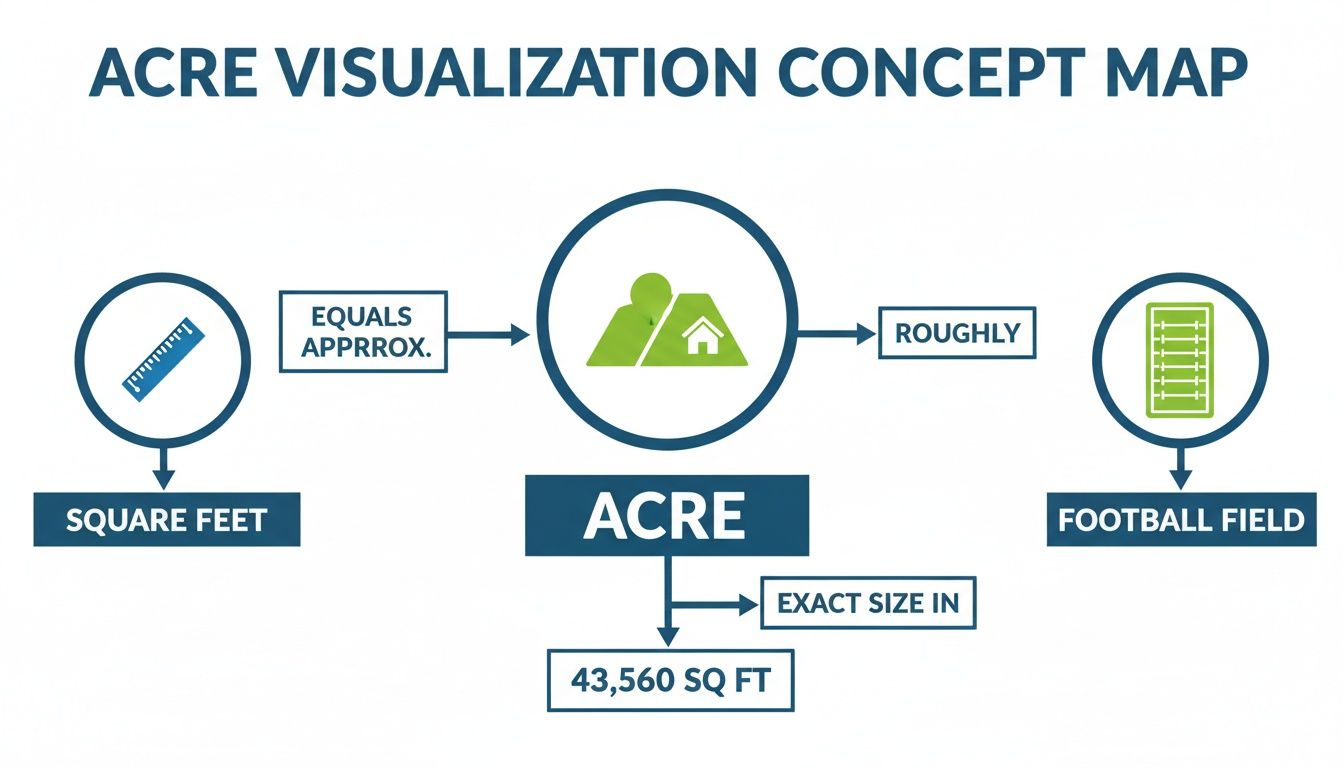
This simple comparison helps frame just how much space you're getting, making it much easier to evaluate listings across the Okanagan real estate market.
The numbers can feel a bit abstract, so I've put together a quick reference table to help you compare different land measurements you'll see in Okanagan real estate listings.
Acreage at a Glance: Common Conversions
Unit Square Feet Square Metres Visual Comparison (Approx.)
1 Acre | 43,560 sq. ft. | 4,046.86 sq. m. | ~90% of a Canadian football field |
Half-Acre | 21,780 sq. ft. | 2,023.43 sq. m. | About 4.5 standard city lots |
Quarter-Acre | 10,890 sq. ft. | 1,011.71 sq. m. | A very large suburban backyard |
5 Acres | 217,800 sq. ft. | 20,234.3 sq. m. | Roughly 4.5 football fields |
10 Acres | 435,600 sq. ft. | 40,468.6 sq. m. | About 9 football fields |
This table should make it easier to translate listing details into a real-world picture of the property's size and potential.
Putting Kelowna's Size into Perspective
To truly grasp the opportunities here, it helps to understand the scale of our beautiful region. The city of Kelowna itself covers 211.85 square kilometres, which translates to a whopping 52,350 acres of land. That's a huge canvas for real estate.
This massive footprint supports a fantastic mix of urban neighbourhoods, lush parks, and sprawling agricultural zones—perfect for everyone from first-time home buyers to seasoned investors.
When you zoom out to include Greater Kelowna—the census metropolitan area—it balloons to roughly 717,500 acres. This wider area includes West Kelowna, Lake Country, and Peachland, offering an incredible variety of properties from luxury lakefront homes to quiet family estates. You can explore more about what makes Kelowna's geography so special on WorldAtlas.com.
The key takeaway is simple: whether you’re looking for a small parcel or a massive estate, the Okanagan has the space and variety to match your vision. Understanding the scale is the first step toward finding your perfect property.
From Small Parcels to Large Estates
When you start your property search, you'll see a wide range of sizes. Here’s a breakdown of what you might encounter in the Kelowna real estate market:
Under 1 Acre: Often found within city limits, these larger lots offer more space than a standard suburban property, giving you room for a bigger garden, a pool, or a workshop.
1 to 5 Acres: This is a popular range for those wanting a hobby farm or just more privacy without being too far from amenities in places like East Kelowna or Ellison.
5 to 20+ Acres: Common in rural areas surrounding Kelowna and Vernon, these larger parcels offer significant space for agriculture, recreation, or building a completely private dream home.
Knowing these common sizes helps you narrow down your search and focus on listings that truly fit your lifestyle goals.
How to Determine the Value of Acreage in Kelowna
Figuring out what a piece of land is truly worth goes far beyond its size. Two five-acre parcels here in the Okanagan can have wildly different price tags, and it's our job at Vantage West Realty to help you understand why. The true value of acres of land is a story told by location, access, and potential.
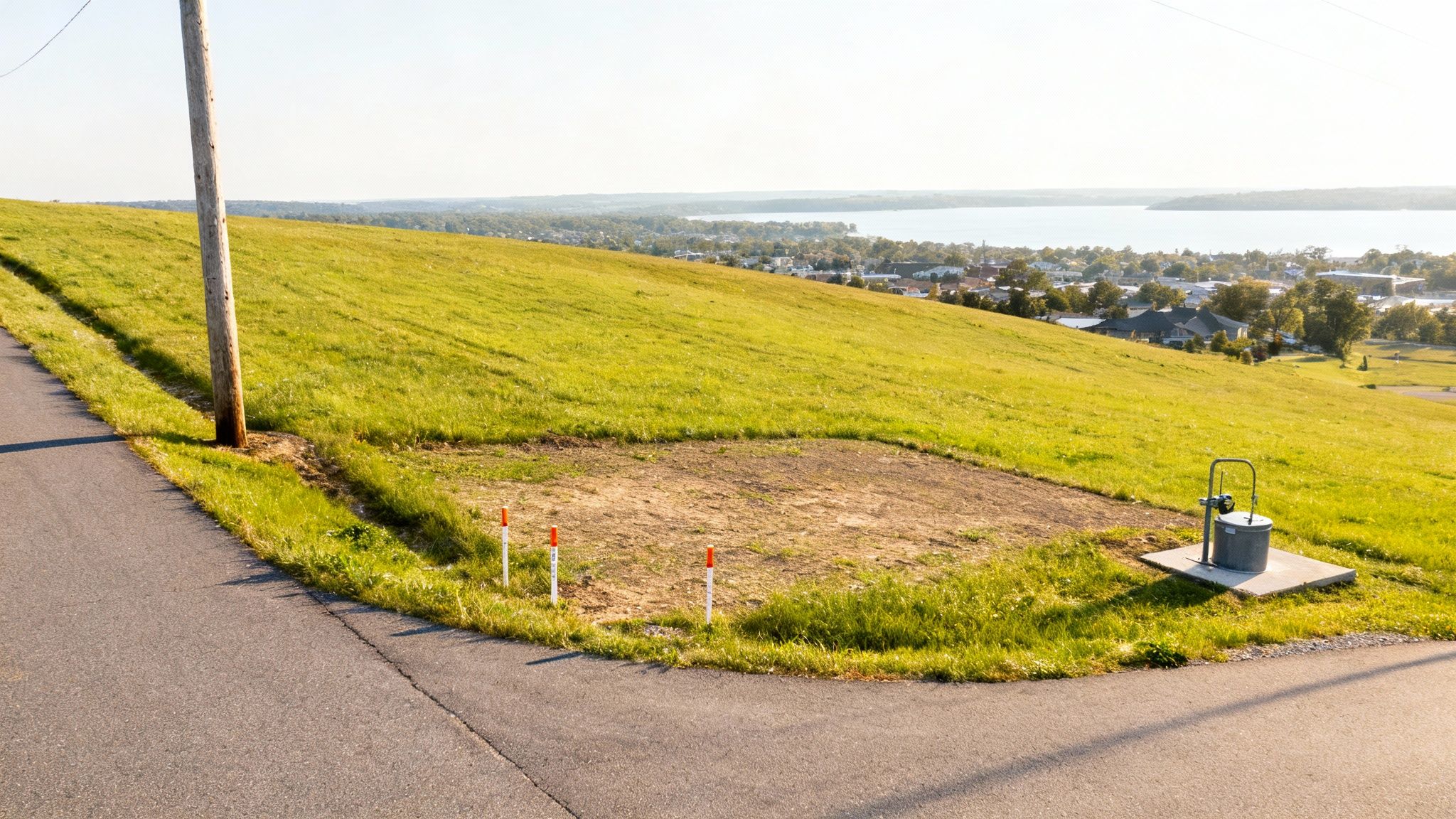
Let's dive into the critical factors that determine what a property is really worth in the Kelowna real estate market. This will help you look past the listing price to see the genuine opportunity.
Location Still Rules Everything
You’ve heard it a million times, but with land, "location, location, location" takes on a whole new meaning. A parcel of land in the Lower Mission has a completely different value proposition than an identical one out near Big White.
Proximity to Kelowna, West Kelowna, or Vernon city centres, schools, and amenities adds serious value. Easy access to major arteries like Highway 97 is another huge plus, whether for future development or just your daily commute.
And of course, views are a massive factor here in the Okanagan. A property with a protected, sweeping view of Okanagan Lake will always command a premium.
Accessibility and Utilities Are Game-Changers
How easily can you actually get to and use the land? This is a fundamental question that directly hits the price tag. A property with paved, year-round road access is far more valuable than one you can only get to via a rough, seasonal dirt track.
The availability of utilities is just as important. Having services already at the lot line is a huge advantage and a major cost-saver.
Municipal Water and Sewer: This is the gold standard. A property hooked into the city's grid is ready for development and highly desirable.
Well and Septic: Many rural properties rely on wells for water and septic systems for waste. You'll need to budget for the costs of drilling a well and getting a septic system approved and installed.
Power and Gas: Is there a power pole nearby? How far would you need to run lines? These costs can add up fast and will absolutely affect the land's value.
A property that seems like a bargain might lose its appeal once you calculate the $50,000+ it could cost to bring in essential services. This is a critical part of your due diligence when assessing different acres of land.
Topography and Usability of the Land
The physical characteristics of the land—its topography—play a massive role in its usability and, therefore, its value. A flat, usable acre is almost always worth more than a steeply sloped one.
Think about it: building a home on a steep hillside is far more complex and expensive. The foundation work alone can become a major budget item. While a slope might deliver those incredible views, you have to weigh that against the practical challenges and costs. For a deeper dive, you can learn more about how to determine fair market value for any property.
The Power of Highest and Best Use
This is a concept that seasoned investors and developers live by. It means valuing a property based on its most profitable, legal, and feasible potential use. A large, flat parcel of land on the edge of Kelowna might be used for a single-family home, but its 'highest and best use' could be for a multi-unit townhouse development.
Understanding this principle helps you see the hidden potential in a piece of land. It’s about looking past what’s there now and seeing what it could become. This is where an experienced real estate team provides immense value, helping you identify opportunities that others might miss in the Okanagan real estate market. We help you think like an investor, ensuring your purchase is a smart one for the long haul.
Navigating Kelowna's Zoning and Land Use Rules
So, you've found a few acres that look perfect. The views are incredible, the location feels right, and you can already picture your future home or hobby farm. This is the exciting part, but it’s also where your vision meets reality. Before you get too far down that road, it's absolutely critical to understand what you're actually allowed to do with the property.
Buying acreage isn’t just about the space; it’s about the rulebook that governs that space. Every single parcel of land in Kelowna and the Central Okanagan is subject to zoning and land use bylaws. These regulations are the city's blueprint for growth, and they will directly impact your plans.
Think of zoning as a set of instructions for a property. It spells out what can be built, where it can be put, and what the land can be used for. Ignoring these rules is a recipe for frustrating delays and expensive mistakes, but understanding them empowers you to make a smart, confident purchase.
Understanding Common Zoning Types
Here in the Okanagan, you'll generally come across a few key zoning types when you’re looking at acres of land. Each comes with its own unique set of possibilities and limitations. Getting familiar with them is the first step in matching a property to your actual goals.
Let's break down the most common ones you'll see:
Residential (RU) Zoning: This is what you'll find in more developed areas. It's meant for housing, but the 'RU' categories vary a lot, allowing for single-family homes, duplexes, or even larger lots that feel almost rural while still being close to amenities.
Rural (RR) Zoning: This zoning often applies to larger parcels on the outskirts of town, like you'd find in parts of West Kelowna or Ellison. It typically allows for a single-family home and sometimes an accessory building, offering more space and privacy.
Agricultural (A1) Zoning: Now, this is where things get really specific. These properties are intended for farming. While they usually permit a primary residence, the main focus—and the rules—revolve around agricultural use.
Knowing the zoning designation of a property is non-negotiable. It’s the difference between building your dream workshop and being told you can only put up a barn.
The Agricultural Land Reserve (ALR) Explained
If you're looking for acreage in the Okanagan, you will absolutely run into the Agricultural Land Reserve (ALR). This is a provincial-level designation created to protect valuable farmland, and it plays a massive role in our local real estate market.
A property inside the ALR has an extra layer of rules on top of its local zoning. The Agricultural Land Commission (ALC) has the final say on how this land can be used. This means that even if a property seems perfect for a small subdivision or a non-farm business, the ALR designation could stop those plans cold.
It’s easy to look at a large, beautiful piece of land and see endless potential. If it's in the ALR, that potential is viewed through an agricultural lens first and foremost. This is a crucial detail that shapes the property's true value and usability.
That said, the ALR also presents unique opportunities. It preserves the stunning rural character of areas like Southeast Kelowna and protects the agricultural heritage that makes our region so special. For buyers dreaming of starting a winery, an orchard, or a market garden, an ALR property is exactly what you need.
Farming is woven into the fabric of our city's identity. In fact, within Kelowna's 52,350 acres of city proper, a massive 55%—or over 28,800 acres—is zoned for agriculture. This land supports the iconic tree fruits and vineyards that define the Okanagan. Of this, about 11,520 acres are protected within the ALR, safeguarding our most fertile soils from urban sprawl. You can find more insights on Kelowna's agricultural roots over at CareerBeacon.com.
Due Diligence is Your Best Friend
So, how do you make sure your plans and the rules actually line up? The key is thorough due diligence, and this is where having an experienced real estate team in your corner makes a world of difference. We help you ask the right questions and get the official answers before you ever write an offer.
Here’s a practical checklist to get you started:
Confirm the Official Zoning: First things first. We'll pull the property's official records from the City of Kelowna or the relevant regional district.
Check for ALR Status: We verify if the property is in the Agricultural Land Reserve—a critical piece of the puzzle you can't afford to miss.
Review the Bylaws: We dig into the specifics and help you understand what's permitted under that zoning—from the size of home you can build to whether a secondary suite is even an option.
Investigate Easements and Covenants: Are there any registered restrictions on the title that could limit your plans, like a right-of-way for a neighbour or a strict no-build zone?
Navigating these details can feel like a maze, but it’s a standard part of our process here at Vantage West Realty. We make sure you have the complete picture of a property's potential and its limitations, so you can move forward with total confidence.
The Impact of Environmental Factors on Okanagan Land
Living in the beautiful Okanagan means understanding and respecting its unique environment. When you're buying acres of land, what happens with the weather and the landscape isn't just small talk—it directly impacts your investment, safety, and lifestyle.
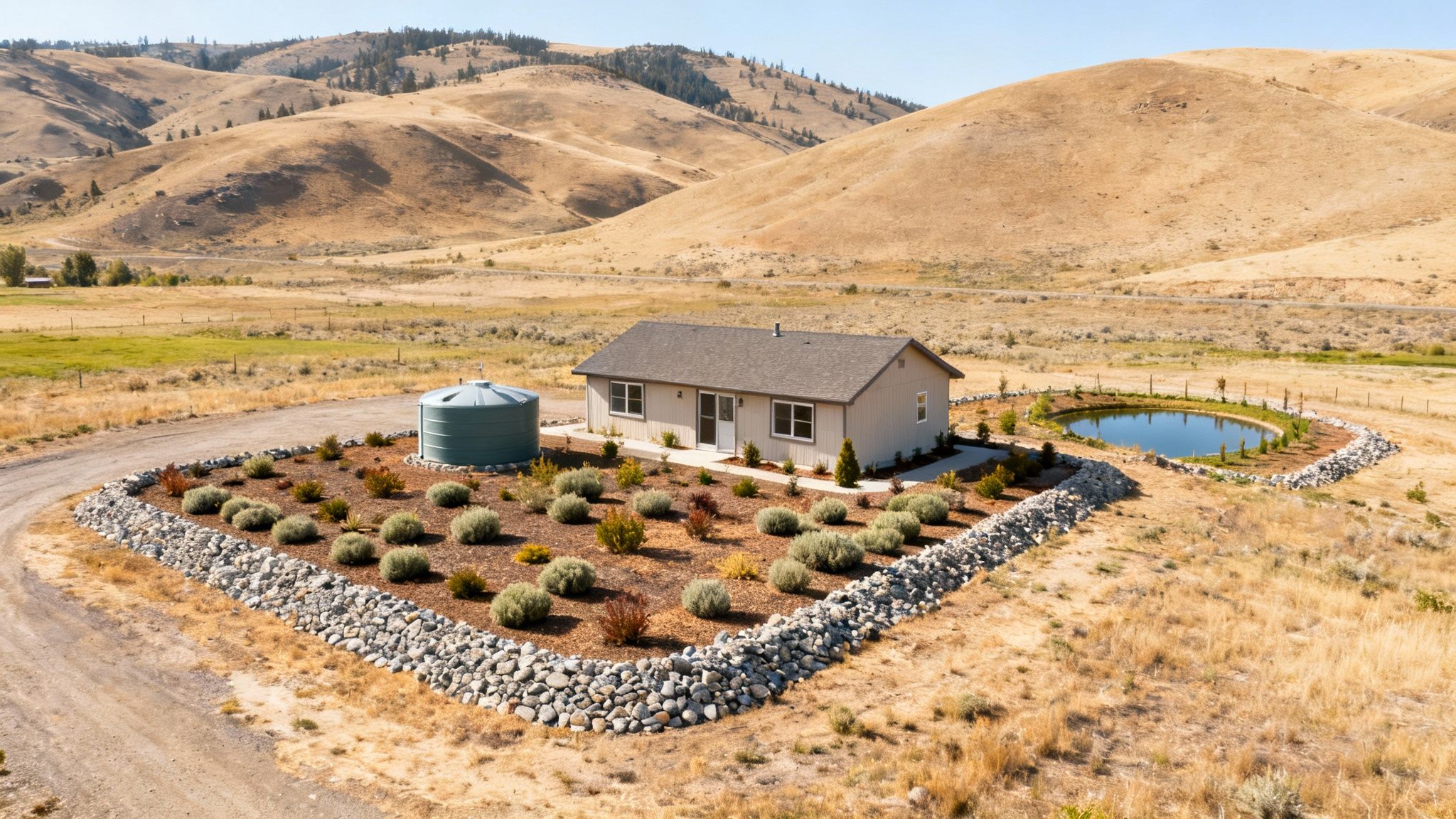
From the risk of summer wildfires to the availability of water, these natural factors are a critical part of your due diligence. Thinking about them now protects your property and ensures it remains a safe, sustainable place to call home for years to come.
Living with Wildfire Risk
It's no secret that our hot, dry summers come with a significant risk of wildfires. For anyone buying property, especially on the beautiful hillsides overlooking the valley, this is a top consideration. Properties located in what’s known as the wildfire interface zone—where homes meet wildland—require special attention.
Understanding this risk is about being prepared. We help our clients investigate a property's history and proximity to high-risk areas. Adopting FireSmart principles is a practical and powerful way to protect your investment.
These principles include common-sense steps that make a huge difference:
Creating Defensible Space: This involves clearing flammable materials like dry leaves, pine needles, and dead wood from the area immediately around your home.
Choosing Fire-Resistant Landscaping: Opting for plants that are less flammable can significantly slow a fire's spread.
Using Fire-Resistant Building Materials: When building or renovating, materials like metal roofing and stucco siding offer much greater protection.
Wildfires have undeniably shaped land use and real estate strategies here. The August 2015 Little White Mountain fire burned 320 acres just south of Kelowna, while the Joe Rich fire in 2017 scorched nearly 990 acres, leading to hundreds of evacuations. These events prompted stronger fire-smart building practices, which is something our clients now look for when seeking secure, high-value homes. You can learn more about Kelowna's history with these events on Wikipedia.
Water Rights and Availability
In our semi-arid climate, water is gold. You can’t just assume that buying a piece of land automatically gives you the right to use water, and this is a detail that trips up many unprepared buyers. Understanding a property's water source is just as important as checking its zoning.
The source of your water will dramatically affect your lifestyle and what you can do with your land, especially if you have agricultural ambitions.
Having a secure, legal, and reliable water source is non-negotiable when buying acres of land in the Okanagan. It’s a foundational element of the property's value and usability.
Types of Water Sources
Here’s a breakdown of the common water situations you'll encounter in the Okanagan real estate market:
Municipal Water: This is the simplest and most reliable source. If a property is connected to a municipal system (like the City of Kelowna's), you have a steady supply for domestic use. This is typical for lots within or near city limits.
Wells: Many rural properties rely on a drilled well. If this is the case, you'll need to verify the well log to check its depth, flow rate (gallons per minute), and water quality. A good, productive well adds significant value to a property.
Irrigation Rights: For larger parcels, especially those in the ALR, you might see "irrigation rights" mentioned. This refers to a license to draw a specific amount of water from a nearby source, like a creek or lake, strictly for agricultural purposes. These rights are incredibly valuable but also complex to navigate.
Creating a landscape that thrives in our climate is also key. For more tips, check out our guide on low-water landscaping ideas and xeriscaping.
Financing Your Purchase of Acres of Land
Securing a loan to buy raw acres of land isn't quite the same as getting a mortgage for a house. It’s a different ball game, but with the right guidance, it's a game you can absolutely win. We're here to give you the straight talk on how to finance your acreage purchase right here in the Kelowna market.
From a lender's perspective, raw land is a higher-risk investment. A house can be lived in immediately, making it straightforward collateral. Undeveloped land, on the other hand, doesn't generate income and can be harder to sell quickly if a borrower defaults.
This higher perceived risk usually means a few things for you as a buyer. You'll likely need a larger down payment—often between 20% and 50%—and you may see slightly higher interest rates compared to a traditional home mortgage. It's the bank's way of balancing their risk, and knowing this upfront helps you prepare your finances realistically.
Your Financing Options for Land
The good news is you have several paths you can take to secure the funds for your dream property. The best option will depend on your specific situation, your credit, and your plans for the land.
Here are the most common financing routes you'll encounter in the Okanagan real estate market:
Conventional Land Loans: Offered by banks and credit unions, these are specialized loans for buying undeveloped land. They are the most traditional route but often come with the strictest requirements for credit scores and down payments.
Seller Financing: Sometimes, a property owner is willing to act as the lender. This arrangement can offer more flexible terms, potentially lower closing costs, and a faster process. It's always worth exploring, especially with larger, rural parcels.
Construction Mortgages: If your plan is to buy the land and start building your dream home right away, a construction mortgage could be perfect. This type of loan covers the cost of both the land and the construction, releasing funds in stages as building milestones are met.
Understanding your mortgage options is a critical step in your home-buying journey. It’s about finding the financial tool that best fits your goals, whether you're buying a condo or ten acres of pristine Okanagan land.
Getting Yourself "Loan-Ready"
Positioning yourself as a strong, reliable borrower is key to getting approved for a land loan. Lenders will be looking closely at your financial stability and your plans for the property. Getting your ducks in a row before you approach a lender will make the entire process smoother.
To put your best foot forward, focus on a few key areas. First, organize your financial documents, including proof of income, tax returns, and statements for your assets. Next, have a clear and detailed plan for the land. Will you build immediately? Do you have a budget for bringing in utilities? Presenting a well-thought-out vision shows the lender you're a serious and prepared buyer.
Finally, getting pre-approved is a powerful move. It gives you a clear budget to work with and shows sellers that you’re a credible buyer ready to make a move. For more detailed guidance, you can explore our in-depth article on which mortgage is right for you. This preparation is your financial roadmap to making your dream of owning land a reality.
Your Next Steps to Owning Land in the Okanagan
Alright, you've made it this far. You know how to picture an acre, what gives a piece of land its value, and you’ve got a handle on the rules and environmental checks that come with the territory. Now, let’s bring it all together and turn that knowledge into a real plan for finding your slice of the Okanagan.
This is where the dream starts feeling real. The path to owning land is an exciting one, but it’s not a journey you should take on your own. Honestly, the single most important thing you can do right now is build the right team.
Assemble Your A-Team
Buying land has a lot of moving parts, and each one requires a specific kind of expertise. Having a crew of trusted pros in your corner isn't just a good idea—it's essential. They’re the ones who will help you spot the hidden gems, sidestep the costly mistakes, and make sure your interests are protected from start to finish.
Here's who you need on your team:
A Trusted REALTOR®: This is your guide on the ground. You need an agent with serious experience in Okanagan land deals, like our team at Vantage West Realty. We get the local quirks, from ALR regulations to water rights. We’ll find the right property and fight for the best possible terms for you.
A Real Estate Lawyer: Your lawyer dives into the nitty-gritty legal details. They'll handle the title review, check for any easements or restrictive covenants that could limit your plans, and ensure the ownership transfer is clean and seamless.
A Surveyor: Got any questions about exactly where your property lines are? Wondering about the precise placement for your future home? A surveyor gives you the official, undeniable measurements you need for total peace of mind.
Having a coordinated team of experts transforms a complicated process into a managed one. It gives you the confidence to move forward, knowing every detail has been professionally handled.
Define Your Vision and Let's Get Started
With your team assembled, it's time to get crystal clear on your goals. What do you really want out of this property? Are you planning to break ground on a custom home right away, or is this more of a long-term investment play? Your answers will guide the entire search for the perfect acres of land.
This is the moment where everything we’ve talked about clicks into place. From judging the slope of the land and checking for utility access to untangling the local zoning rules, every bit of due diligence is critical. We'll help you connect the dots, applying these concepts to actual listings in Kelowna, Vernon, or Penticton.
If you’re ready to start looking at buying or selling land in the Okanagan, Vantage West Realty is here to help you make your next move with confidence. Give us a call today, and let's find your perfect piece of the valley.
Common Questions About Buying Acres of Land
Thinking about buying a few acres of land? It’s a big step, and if you’ve only ever bought a house before, the whole process can feel a bit new. We get it, and it’s completely normal to have a ton of questions.
Let's walk through some of the most common ones we hear from clients looking to buy land here in Kelowna and the Okanagan. We'll give you the straight goods to help you move forward with confidence.
How Much of a Down Payment Do I Need for Land?
This is almost always the first thing people ask. With a typical home mortgage, you might get away with as little as 5% down. But when it comes to raw land, lenders see things differently and they want you to have more skin in the game.
As a general rule, you should be prepared for a down payment of at least 20% to 25%. For some properties, especially very large or remote parcels, some lenders might even ask for up to 50% down. The final number really depends on the lender, your own financial picture, and the specific piece of land you're eyeing.
How Do I Get Utilities to a Rural Lot?
So you’ve found that perfect piece of paradise, but it’s completely off-grid. Getting essentials like power, water, and internet hooked up is a huge part of the puzzle. The costs and complexity can swing wildly depending on how far your property is from the nearest service lines.
Electricity: Your first call will be to BC Hydro for an estimate. They’ll look at the distance to the nearest power pole and what the terrain is like. The cost can be a few thousand dollars if you're close, or it could easily climb over $100,000 if it involves running new poles and lines across a challenging landscape.
Water: If you can’t hook into a municipal or community water system, you'll likely need to drill a well. This means bringing in a professional well driller to locate a good water source on your property and install all the necessary pumps and equipment.
Septic System: For wastewater, a septic system is the rural standard. This isn’t as simple as just digging a hole; it requires a percolation test (or "perc test") to make sure your soil can properly handle drainage. After that, a professional will install a system that meets all the local health regulations.
It is absolutely crucial to get quotes for these services before you close the deal. This is the only way to know the true cost of turning that raw land into your dream property.
How Do Property Taxes Work for Undeveloped Land?
Property taxes are a fact of life for any landowner, but they're calculated a little differently for bare land. BC Assessment determines the value of your property, and your taxes are based on that number.
The good news is that undeveloped land is typically assessed at a much lower value than a property with a house on it, which means your annual tax bill will be smaller.
A key thing to remember: the moment you build a home, your property will be reassessed. Your taxes will then go up to reflect the new, higher value of the land plus the improvements (your new home).
This is a critical detail to factor into your long-term budget. Also, if you’re buying land within the Agricultural Land Reserve (ALR) and plan to actively farm it, you might qualify for "farm class" status. This can dramatically lower your property tax bill and is a major perk for anyone with agricultural ambitions in the Okanagan.
If you’re thinking about buying or selling acres of land in Kelowna, Vantage West Realty can help you make your next move with confidence. Reach out today.
Sell Your House With Vantage West Realty
Sell your home on your own time with the Vantage West Guaranteed Home Sale Program.
if your home doesn’t sell in a mutually agreed upon timeframe, we’ll provide you with a guaranteed written offer.