



Strata Fees Meaning: A 2026 Kelowna Home Buyer's Guide

AJ Hazzi, REALTOR®
After becoming a Realtor® in 2002, AJ Hazzi noticed a gap in the real estate market...
After becoming a Realtor® in 2002, AJ Hazzi noticed a gap in the real estate market...
When you're browsing homes for sale in Kelowna, especially in the condo or townhouse market, you’ll see the term 'strata fees' on every single listing. So, what does that actually mean for you as a buyer?
Think of strata fees as your monthly contribution to a shared community fund. It's the money you and your neighbours pool together to keep your building and its common areas safe, clean, and well-maintained.
Why Strata Fees Matter in Kelowna
If you're planning to buy a home in a strata development here in Kelowna, getting a handle on these fees is a critical part of your budget. They're a direct investment in your property's future value and, just as importantly, your day-to-day quality of life.
Let's put it another way. Imagine you own a single-family house. You’re on the hook for absolutely everything: cutting the grass, shovelling the driveway, fixing the roof when it leaks, and paying for the building's insurance. In a strata, all those responsibilities are shared among the owners. Your monthly fee goes into a central pot that takes care of these jobs for everyone.
This central fund is split into two main parts: the operating fund for day-to-day costs and the contingency reserve fund (CRF) for long-term repairs.
The Operating Fund: Keeping Things Running Smoothly
The operating fund is the workhorse of your strata. It covers all the predictable, recurring expenses needed to keep the lights on and the property looking great.
A portion of your monthly fee goes directly into this fund to pay for things like:
Day-to-day upkeep: This is the stuff you see all the time, like landscaping and lawn care in the summer, snow removal in the winter, and keeping common areas like hallways, lobbies, and amenity rooms clean.
Building services: Essential services are also covered here. Think garbage and recycling collection, window washing, and the costs for the professional strata management company that handles the administrative work.
Utilities for common areas: This includes electricity for lighting in the parkade and hallways, gas for heating common rooms, and water for irrigation systems.
The Contingency Reserve Fund (CRF): Planning for the Future
The other chunk of your fee is funnelled into the Contingency Reserve Fund, or CRF. This is the strata’s long-term savings account, and it's legally required in British Columbia.
This fund is specifically for major repairs and replacements that happen less frequently but come with a big price tag. We’re talking about things like replacing the roof in 10 years, upgrading the elevator, or repaving the parkade. A healthy CRF means the strata can handle these big-ticket items without hitting owners with a massive, unexpected bill.
For a deeper dive into the specifics, check out our detailed guide on what is a strata fee.
Ultimately, a well-managed strata with properly allocated fees protects your investment and ensures your building remains a desirable place to live in the Okanagan for years to come.
Breaking Down What Your Monthly Strata Fee Includes
So, where does your hard-earned money actually go each month? It’s a great question. Think of your total strata fee as a pie cut into two very important, but very different, pieces: the Operating Fund and the Contingency Reserve Fund (CRF).
Each one has a distinct job to do in keeping your building running smoothly today while also protecting your investment for the long haul.
The Operating Fund covers all the predictable, day-to-day costs of simply keeping the property maintained. It keeps the lights on, the lawns mowed, and the common areas clean.
The Contingency Reserve Fund is the building’s long-term savings account. This is the nest egg set aside for the big-ticket, infrequent projects that are expensive but totally inevitable.
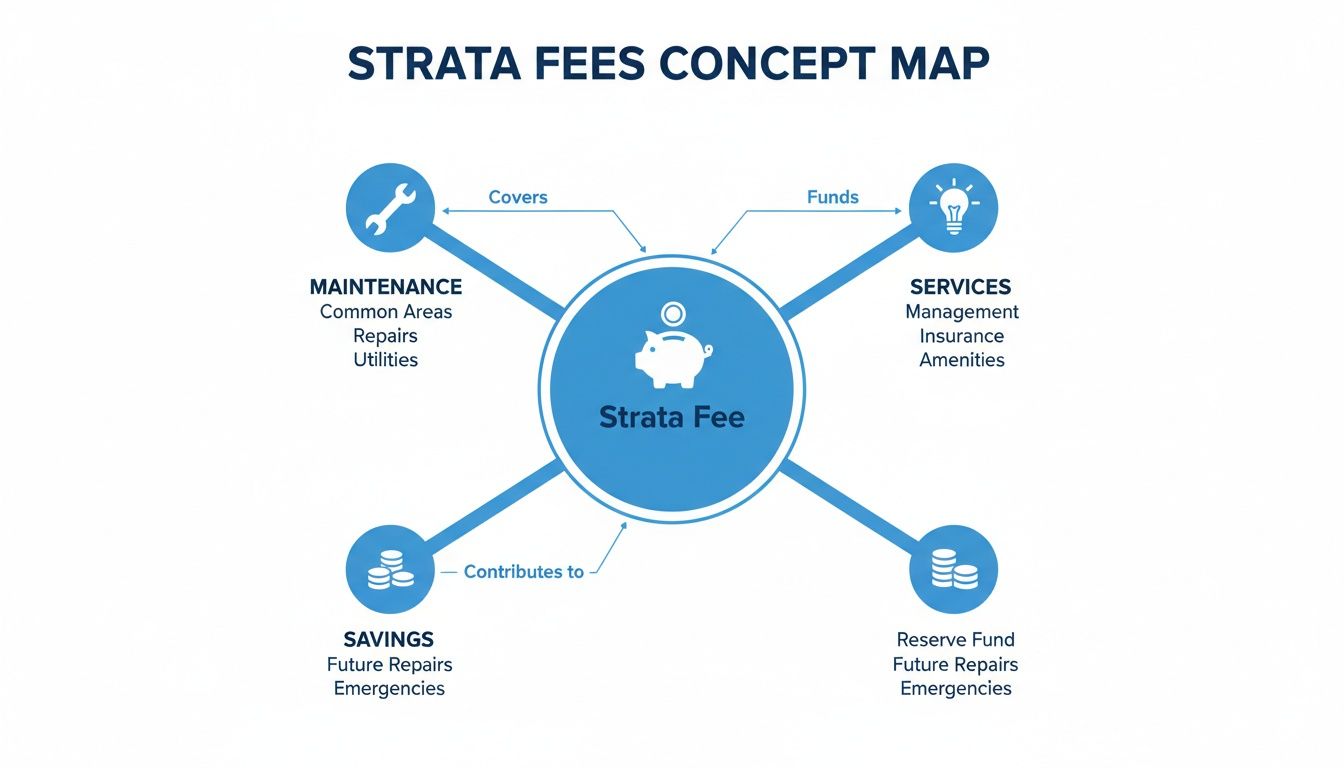
As you can see, your fee is a careful blend of immediate operational costs and future-proofing your home. A well-managed building balances both beautifully.
The Two Pillars of Your Strata Fee
Let's take a closer look at what each of these funds actually handles. Understanding this distinction is absolutely critical to figuring out if a strata corporation is on solid financial ground or heading for trouble.
1. The Operating Fund (Day-to-Day Costs):
This is the fund that pays for the routine, recurring expenses. Think of it like the building's monthly budget.
Maintenance: This covers things like landscaping, snow removal from the parkade entrance, and cleaning the hallways and lobby.
Utilities: It pays for the electricity in common areas, heat for the lobby, and often includes building-wide water and garbage collection.
Administration: This is where the fees for the strata management company, bank fees, and the cost of arranging the annual general meeting come from.
Building Insurance: This is a big one. It’s a crucial policy that covers the replacement cost of the entire structure and all common property.
2. The Contingency Reserve Fund (CRF for Major Repairs):
This is the "rainy day" fund, but for predictable, major expenses that come up over the life of a building. It's designed to prevent financial shocks.
Roof Replacement: A new roof can easily run into the hundreds of thousands of dollars, and the CRF is designed to cover it without bankrupting the owners.
Elevator Modernization: Upgrading an aging elevator is another massive capital expense that needs to be planned for years in advance.
Parkade Repaving: Over decades, concrete surfaces wear out and need significant, costly repairs.
Exterior Painting: Keeping the building’s exterior protected from the Okanagan sun and snow means a full repaint every decade or so—another major project.
A healthy CRF is one of the most important indicators of a well-managed building. An underfunded reserve is a huge red flag that often leads to unexpected special levies, hitting owners with thousands in unplanned costs.
How Are Strata Fees Calculated in British Columbia?
You might think that everyone in a building pays the same strata fee, but that's not how it works. In British Columbia, the process is actually pretty logical, designed to spread the costs fairly across all the owners. It all boils down to a key concept called unit entitlement.
Think of unit entitlement as your home's official slice of the entire strata pie. It's a number that determines your share of ownership in the common property and, as a result, how much you kick in for its upkeep.
The Role of Unit Entitlement
Most of the time, your unit entitlement is based on the habitable square footage of your home. A sprawling three-bedroom penthouse in downtown Kelowna will have a higher unit entitlement than a cozy one-bedroom condo on a lower floor. The bigger your space, the larger your share of the responsibility.
This approach keeps things fair. As per BC government guidelines, these fees are divvied up based on 'unit entitlement'—so a growing family upsizing to a two-bedroom will pay a bit more than downsizers in a one-bed. If you want to dive deeper into the local rules, you can discover more insights about Kelowna strata rules on our blog.
From Annual Budget to Monthly Fee
So, how does the strata turn a big annual budget into your specific monthly payment? The process is refreshingly straightforward:
Annual Budget Creation: Once a year, the strata corporation holds its Annual General Meeting (AGM). This is where they lay out a detailed budget covering all the projected expenses for the next year—everything from landscaping contracts to insurance premiums and contributions to the CRF.
Owner Approval: All the owners get to review this budget and vote on whether to approve it. It’s a democratic process.
Fee Calculation: Once the budget is approved, the total amount is divided by the total unit entitlement of the entire complex. This gives them a cost per entitlement point, which is then used to calculate the exact monthly fee for each individual unit.
This transparent system ensures you're only paying your fair share, giving you clarity and confidence as you budget for your new home in the Okanagan real estate market.
What Are Typical Strata Fees in the Okanagan?
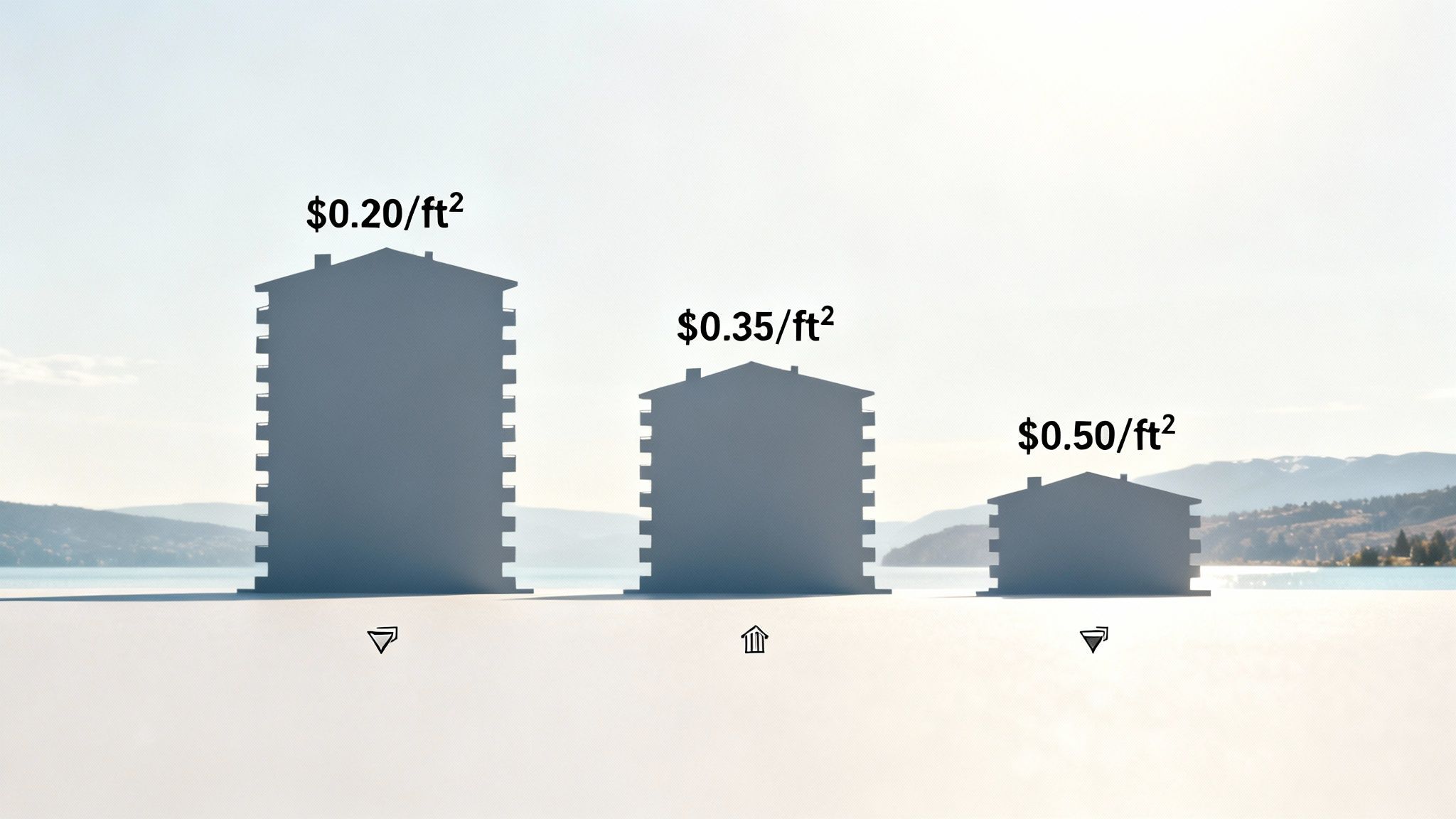
So, what should you actually budget for strata fees when you're looking at homes in and around Kelowna? Every building is unique, of course, but a solid rule of thumb in the Okanagan is to expect something between $0.20 and $0.50 per square foot each month.
Let's break that down. For a smaller 600-square-foot condo, you’re looking at a monthly fee somewhere between $120 and $300. If you're eyeing a more spacious 1,200-square-foot townhome, that range would be closer to $240 to $600. These numbers give you a realistic starting point for your financial planning.
What Drives the Cost Up or Down?
Several key factors will push a building to the higher or lower end of that range. It’s no surprise that a brand-new high-rise in downtown Kelowna, loaded with a pool, gym, and concierge service, will have higher fees than an older, more basic building in Penticton with fewer bells and whistles.
Here’s a quick look at what really moves the needle:
Amenities: Things like swimming pools, hot tubs, fitness centres, and guest suites are great perks, but they all add to the monthly operating costs.
Building Age: Older buildings often need more maintenance and bigger contributions to the contingency reserve fund to prepare for major replacements down the road.
Insurance Costs: Strata insurance premiums have jumped significantly across British Columbia, and that increase gets passed directly to owners through their monthly fees.
Be careful with unusually low strata fees. While they might look great on paper, a super-low fee is often a massive red flag. It can signal a dangerously underfunded reserve, leaving every owner exposed to a huge special levy when a major repair inevitably pops up.
Estimated Monthly Strata Fees in Kelowna
To give you a clearer picture, here’s a look at potential monthly strata fees for various condo sizes in Kelowna, based on that typical $0.20 to $0.50 per square foot range.
Condo Size (Square Feet) Estimated Monthly Fee Range
600 sq. ft. (1-Bedroom) | $120 – $300 |
800 sq. ft. (Large 1-Bed/Small 2-Bed) | $160 – $400 |
1,000 sq. ft. (2-Bedroom) | $200 – $500 |
1,200 sq. ft. (Large 2-Bed/Townhome) | $240 – $600 |
1,500 sq. ft. (Luxury Condo/Townhome) | $300 – $750 |
Remember, these are just estimates. A luxury building with extensive amenities could easily exceed these ranges, while a more basic, self-managed property might fall on the lower end.
Looking ahead to 2025, the average condo fees across BC are hovering around $0.45 per square foot. Here in Kelowna, we always caution buyers and investors to watch out for the "low-fee trap." Those bargain fees often mean the strata is skimping on CRF contributions, leaving the building financially unprepared for the future.
This kind of local knowledge is key to figuring out if a property's fee is reasonable or a sign of trouble brewing. For more specific advice on this, check out our guide on what to expect when buying Kelowna high-rise condos.
The Hidden Risks of Special Levies and Rising Costs
Beyond your predictable monthly fee, there's another potential cost every buyer in the Okanagan needs to get their head around: the special levy.
Think of it as an emergency cash call from the strata corporation. It happens when a major, often unexpected, expense pops up that the Contingency Reserve Fund (CRF) just can't cover. This is for the big-ticket items that need immediate attention.
What Triggers a Special Levy
A special levy is voted on by the owners and can be triggered by a number of things. The bill could be a few thousand dollars for a sudden boiler replacement or balloon to tens of thousands per owner for urgent structural repairs. Spotting the warning signs in the strata documents before you buy is absolutely key.
External pressures are also driving up costs for everyone. The most significant factor lately has been the massive surge in strata insurance premiums across British Columbia, a cost that gets passed directly on to you.
Just last year, strata insurance premiums jumped by an average of 40% across BC. While over half of properties saw increases under 30%, a significant 15% faced hikes of 50% or more, and some even saw their deductibles triple.
These rising costs put immense pressure on strata budgets. When the operating fund can't absorb such a dramatic increase, it often leads to higher monthly fees or even a special levy just to cover the insurance shortfall. You can read more about these strata insurance trends in BC to see the full picture.
Understanding these financial risks is crucial for anyone buying a strata property in Kelowna. It protects you from a costly and stressful surprise down the road, ensuring your investment is a secure one.
How To Review Strata Documents Before You Buy
The best way to protect your investment is to do your homework. That means carefully reviewing all the strata documents before you even think about making an offer.
These documents are like a report card on the building’s financial and physical health, revealing everything from hidden disputes to future costs you’ll be on the hook for.

This due diligence is a vital part of the home buying process in Kelowna. We guide our clients through this crucial step, helping them uncover any red flags that could turn their dream home into a financial nightmare.
Key Documents To Examine
When you get the document package, zero in on these three items. Together, they tell a detailed story about the community you're considering joining.
Meeting Minutes (AGM & Council): Reading the last two years of minutes shows you the real-life issues. Look for repeat complaints about leaks, noise, or owner disputes. Consistent problems can signal poor management or unresolved conflicts that aren't going away anytime soon.
Depreciation Report: Think of this as the building's long-term health plan. It outlines the expected lifespan and replacement cost of major components like the roof, windows, and plumbing. Check if the Contingency Reserve Fund (CRF) is on track to cover these future expenses. A poorly funded plan is a direct warning of a future special levy.
Form B Information Certificate: This document provides a current snapshot of the specific strata lot you're interested in. It officially states the current monthly fees, any outstanding debts owed by the current owner, and the balance of the reserve fund.
Reviewing these documents is your best defence against buying into a poorly run building. It helps ensure you’re joining a healthy, proactive community that protects your investment.
At Vantage West Realty, we believe an informed buyer is a confident buyer. Our team has the expertise to help you analyze these reports, ensuring you make a smart move.
Common Questions About Kelowna Strata Fees
We've helped hundreds of clients work through the Kelowna real estate market, and strata fees always bring up some fantastic questions. To help you feel more confident, we've put together the most common ones we hear, along with clear, straightforward answers from our team.
Can Strata Fees Increase Every Year?
Yes, and it's quite common for strata fees to go up annually. Think of it like a household budget—each year, the strata council has to forecast upcoming costs for maintenance, insurance, and contributions to the reserve fund.
They present this new budget to all the owners, who then vote to approve it at the Annual General Meeting (AGM). Things like inflation, climbing insurance premiums, or a strategic decision to build up the reserve fund can all lead to a yearly adjustment.
Are Utilities Included in Strata Fees?
This really varies from one building to the next, so you have to check the specifics. Many strata fees will cover common area utilities (like the power for hallways and parkades), garbage disposal, and sometimes centralized hot water or natural gas.
However, your own in-suite hydro, internet, and cable are almost always separate bills you'll need to pay yourself. It's crucial to review the strata bylaws and the Form B document to see exactly which utilities your fee covers before you write an offer.
What Happens If I Stop Paying My Strata Fees?
Not paying your strata fees is a serious issue with significant consequences. The strata corporation has the power to charge interest on any overdue amounts and, more importantly, can place a lien on your property.
A lien is a legal claim that prevents you from selling or refinancing your home until the debt is paid in full. In the most severe cases, the strata corporation can even get a court order to force the sale of your unit to recover what's owed. It's a situation you want to avoid at all costs.
Getting a handle on strata fees is a huge part of buying a condo or townhome in the Okanagan. Knowing what’s covered, how fees are determined, and what to look for in the documents empowers you to make a smart, confident investment.
If you’re thinking about buying or selling a strata property in Kelowna, Vantage West Realty can help you make your next move with confidence. Reach out today to get expert guidance.
Sell Your House With Vantage West Realty
Sell your home on your own time with the Vantage West Guaranteed Home Sale Program.
if your home doesn’t sell in a mutually agreed upon timeframe, we’ll provide you with a guaranteed written offer.